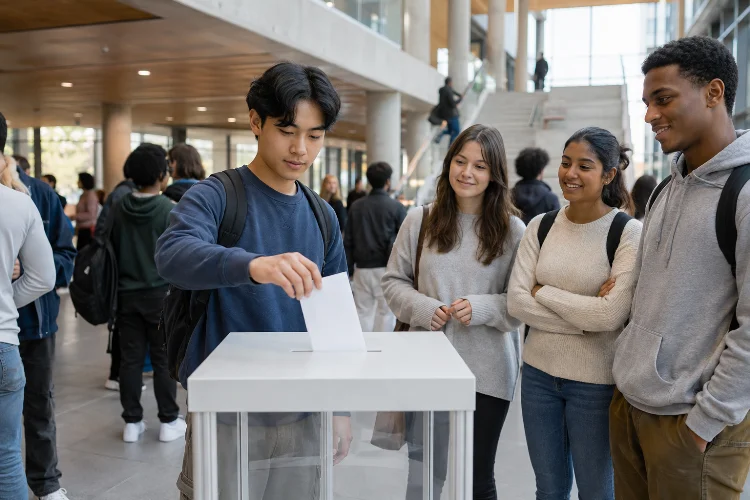
Student union elections can seem surprisingly complicated when you see them for the first time.
One week you are walking past campaign posters on campus, the next your inbox is full of candidate statements, and suddenly everyone is being asked to vote for presidents, education officers, welfare representatives, trustees, or society leaders.
Behind all that activity is a democratic process designed to decide who will represent students during the next academic year.
Although student union elections vary between universities, most follow a similar structure.
Candidates nominate themselves, publish a manifesto, campaign for support, and then eligible students vote. Rules are normally in place to make sure candidates compete fairly and that the ballot remains confidential.
For example, Students’ Union UCL and Imperial College Union both run structured election periods that separate nominations, campaigning, voting, complaints, and results.
Understanding how these stages work makes it easier to participate confidently, whether you plan to run for office or simply want to cast an informed vote.
1. The Process Usually Starts With Nominations
Before anybody can campaign, candidates normally need to officially enter the election.
This stage is known as the nomination period. Students select the position they want to run for and submit the required information through the union’s election system.
Eligibility depends on the role.
A university-wide officer position may be open to most current students, while a faculty representative usually needs to belong to that faculty. Similarly, society elections may only allow members of that particular organisation to stand.
Imperial College Union, for example, requires candidates to meet the specific eligibility requirements attached to each role and checks their status before campaigning begins. Some positions can also require another student to support, or “second,” the nomination.
Always check eligiblity rules before preparing an entire campaign. Discovering after nominations close that you cannot stand for the role is a painful way to learn the process.
2. Candidates Usually Prepare a Manifesto
Once nominated, candidates need to explain why students should vote for them.
This is normally done through a manifesto or candidate statement.
A manifesto outlines the candidate’s priorities, values, and proposed changes. Someone running for education officer might focus on assessment feedback and study spaces, while a welfare candidate could prioritise mental health support or affordable campus services.
The strongest manifestos are usually specific.
“Make university better for everyone” sounds positive but tells voters almost nothing. A promise to campaign for extended library opening during examination periods gives students something much clearer to evaluate.
Imperial College Union runs manifesto workshops to help candidates understand student issues and develop their election commitments, showing how seriously these statements can be treated.
Candidates should also avoid promising things they have no authority to deliver.
A realistic manfiesto explains what the officer can influence rather than pretending one student leader can personally rewrite every university policy.
3. Campaigning Begins Under Specific Rules
After candidates are confirmed, the visible part of the election usually begins.
Campaigning may take place through posters, social media, conversations, student events, lecture visits, debates, videos, or online messaging.
This is where candidates try to persuade students that their ideas deserve support.
However, campaigning is rarely a complete free-for-all.
Unions normally create election rules covering spending, use of union resources, communications, endorsements, campaign materials, data protection, and behaviour toward other candidates.
For example, UCL’s current election rules prevent candidates from gaining unfair advantages through resources or communication channels unavailable to competitors. They also place restrictions on unsolicited messages and require secret voting.
Imperial likewise publishes detailed rules concerning campaign materials and candidate activity.
These rules exist because fair campaining matters. A candidate who already holds a powerful society position should not automatically gain access to resources unavailable to everyone else.
4. Students Vote During a Defined Voting Period
Once voting opens, eligible students can select their preferred candidates.
Most modern university elections use secure online voting platforms, although exact arrangements vary.
Voting is usually confidential. Candidates should not be able to see who voted for them or how individual students ranked candidates.
In the UK, there is also a broader legal foundation for major union elections.
Section 22 of the Education Act 1994 states that appointments to major union offices should be made through elections using a secret ballot in which union members are entitled to vote, and universities should take reasonable steps to ensure those elections are conducted fairly.
Student unions can add more detailed local rules on top of that framework.
Voting windows are often relatively short. For example, Imperial’s 2026 Leadership Elections scheduled voting across four days, while UCL’s 2026 representative elections also used a defined voting week.
If you intend to vote, checking the deadline matters. Unlike an assignment, there is usually no late submission option.
5. Many Student Elections Use Preferential Voting
Student union elections do not always operate on a simple “whoever gets the most votes wins” system.
Many use preferential voting.
In this system, voters rank candidates rather than choosing only one. You might place one candidate first, another second, and someone else third.
Imperial College Union explains that its elections use a Single Transferable Vote system, commonly called STV. Votes can transfer between candidates according to voter preferences as candidates reach the required quota or are eliminated.
UCL also uses transferable voting and includes a “Re-Open Nominations,” or RON, option in its elections.
RON allows students to indicate that they would rather reopen the election than elect the listed candidates.
Why Ranking Candidates Matters
Suppose your favourite candidate is unlikely to win.
Under a transferable system, your vote does not necessarily become useless. If that candidate is eliminated, your next preference may still influence the final outcome.
This is why students should understand the voting instructions before clicking randomly through the ballot.
Ranking candidates thoughtfully can provide a more detailed picture of voter preferences than a simple single-choice system.
6. Election Rules Protect Fairness and Transparency
Every serious election needs rules, and student democracy is no exception.
Candidates may disagree about posters, endorsements, campaign spending, social media messages, or whether another campaign gained an unfair advantage.
For that reason, many unions appoint a Returning Officer or similar official to oversee the process.
Their job may include interpreting election rules, investigating complaints, checking candidate conduct, and ensuring that the count follows approved procedures.
Some universities also create independent oversight arrangements. Bristol Students’ Union, for example, describes the use of an external Returning Officer for elections to major union offices as part of its framework for ensuring elections are properly conducted.
Good election governance is not about making campaigning boring. It is about creating transparancy so candidates know the same rules apply to everyone.
Students should also be able to find election regulations before voting starts rather than discovering them only after a dispute occurs.
7. Complaints Can Be Raised Before Results Are Finalised
What happens if a candidate believes someone broke the rules?
Most unions have a formal election complaint procedure.
The deadline can be surprisingly tight. At UCL’s 2026 representative elections, for example, voting was scheduled to close at noon and the complaint deadline followed shortly afterward.
Imperial’s 2026 Leadership Elections similarly placed the complaints deadline on the same day voting closed.
Complaints normally need more than rumours.
A student alleging that another candidate misused a mailing list, exceeded campaign spending, or intimidated voters may need to provide screenshots, messages, photographs, or other supporting evidence.
The election official can then decide whether a rule was actually breached and whether any sanction is appropriate.
Possible responses might range from warnings to campaign restrictions or other penalties permitted under local rules.
The important lesson is simple: candidates should read the rules before campaigning, not after something goes wrong.
8. Results Are Announced and Successful Candidates Prepare for Office
After voting closes and any immediate issues are resolved, the union counts the votes and announces the winners.
The exact timing varies. Some results are published online, while major elections may have a formal results event.
Winning, however, is not the end of the process.
New officers may need training before taking office. They may learn about governance, finance, student representation, university structures, safeguarding, campaigning, or responsibilities attached to trustee positions.
For example, UCL’s 2026 representative election schedule includes training-related activities following the election for successful candidates.
This transition matters because being a popular candidate and being an effective officer require different skills.
Campaigning is about persuading people to support your ideas. Governing involves negotiation, compromise, committee work, evidence, budgets, and accountability.
The result annoucement is therefore really the beginning of the next stage.
Why Student Union Elections Matter
It can be tempting to ignore campus elections because they do not feel as important as national politics.
But elected student officers can influence issues that affect university life directly.
They may represent students in discussions about teaching, welfare services, campus facilities, accommodation, societies, accessibility, fees, or university policy.
Imperial describes elected student leaders as representatives who advocate for students on issues such as campus facilities, welfare, academic support, and the wider student experience.
Participation also improves legitimacy.
An officer elected by only a tiny fraction of students can still legally hold the position, but stronger voter participation gives representatives a clearer democratic mandate.
Reading manifestos, asking candidates questions, and voting therefore requires very little time compared with the length of influence successful candidates may have.
Understanding student union elections makes campus democracy much easier to navigate.
Although every university creates its own detailed rules, the typical process includes nominations, eligibility checks, manifestos, campaigning, voting, vote counting, complaints, results, and preparation for office.
The system works best when both candidates and voters participate seriously. Candidates should make realistic promises, follow election rules, and campaign fairly, while students should compare manifestos instead of simply voting for the name they recognise.
When your next campus election arrives, spend a few minutes checking the candidates and learning how your voting system works.
Student officers can influence decisions throughout the academic year, so choosing who represents you is one of the simplest ways to have a voice in university life.